
America has never lacked strong opinions. What we are lacking right now is something far more important: moral clarity that rises above identity, party, and personality.
Today’s public discourse feels less like a search for truth and more like a perpetual courtroom drama, where loyalty to “our side” matters more than the substance of the argument itself. We argue about who is right, who gets credit, who gets blame, who wins, instead of asking the harder and more necessary question: what is right.
This wasn’t always the case.
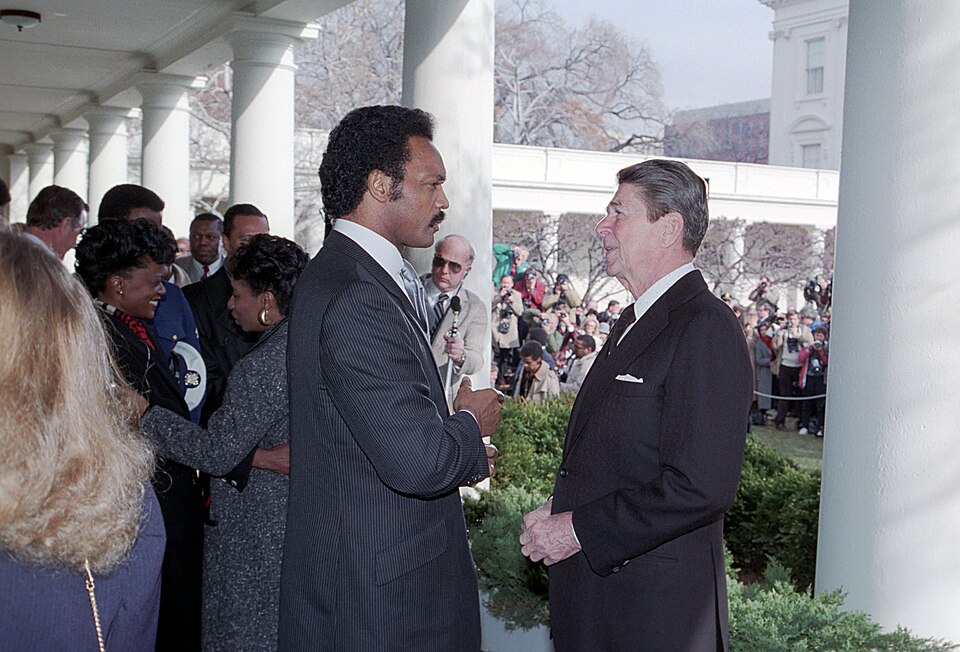
Some of the most influential leaders in modern American history understood that progress does not come from partisan victory, but from moral persuasion. Two figures rarely mentioned in the same breath, Jesse Jackson and Ronald Reagan, offer a surprisingly aligned lesson for this moment.
They did not agree on everything. In fact, they disagreed a great deal. But both believed that leadership required lifting the conversation above faction and into principle.
Jesse Jackson, speaking at the 1984 Democratic National Convention, famously said: “Our flag is red, white, and blue, but our nation is a rainbow.” It was not a call for uniformity. It was a call for shared purpose. Jackson understood that democracy collapses when people reduce one another to labels and lose sight of common values. His civil rights activism was never just about winning arguments; it was about expanding the moral imagination of the country.
He also offered another line that feels especially relevant today: “We may have come over on different ships, but we’re in the same boat now.” That statement cuts directly against the modern instinct to sort, categorize, and dismiss. It reminds us that the stakes of public life are collective, not personal. The question is not who gets to be right, but what choices allow the most people to move forward together.
Ronald Reagan, often remembered primarily as a conservative icon, expressed a strikingly similar sentiment from a different ideological direction. In his 1980 campaign, Reagan said: “There is no such thing as a left or right. There is only an up or down — up toward the maximum of individual freedom consistent with order, or down to the ant heap of totalitarianism.”
Reagan’s point was not partisan; it was philosophical. He believed that arguments should be judged by their outcomes and their alignment with core principles, not by the tribe that advanced them. For Reagan, persuasion mattered more than domination. He sought converts, not enemies.
What unites these two leaders is not ideology, but orientation. Both believed that democracy works best when we argue from values rather than identities. When we ask whether an idea is fair, just, effective, or humane, not whether it helps “our side” win.
That mindset feels increasingly rare.
Social media rewards outrage over reflection. Cable news thrives on conflict over context. Political incentives now favor maximalism, not compromise. In this environment, saying “the other side might be right about this” is treated as weakness rather than wisdom.
But history suggests the opposite. The greatest leaps forward in American life, civil rights legislation, Cold War de-escalation, bipartisan reforms, did not happen because one group crushed another. They happened because leaders reframed debates around shared moral ground.
Today, having a “big voice” should not mean shouting louder or branding opponents as enemies. It should mean speaking clearly about what matters, dignity, safety, opportunity, freedom, and being willing to defend those values regardless of who happens to champion them.
If an idea is right, it should stand even if it comes from someone we dislike. If an idea is wrong, it should be challenged even if it comes from someone we admire. That is the discipline democracy requires.
Jesse Jackson and Ronald Reagan understood something we seem to be forgetting: politics is not supposed to be a permanent identity war. It is supposed to be a moral argument about the direction we choose to go together.
The future will not be shaped by who wins the most arguments online. It will be shaped by whether we recover the courage to argue about what is right, and the humility to accept that truth does not belong to any single tribe.
That is not a call for silence. It is a call for a better, braver kind of voice.
